Beginner's Guide to UK Dragonflies and Damselflies in Wetlands
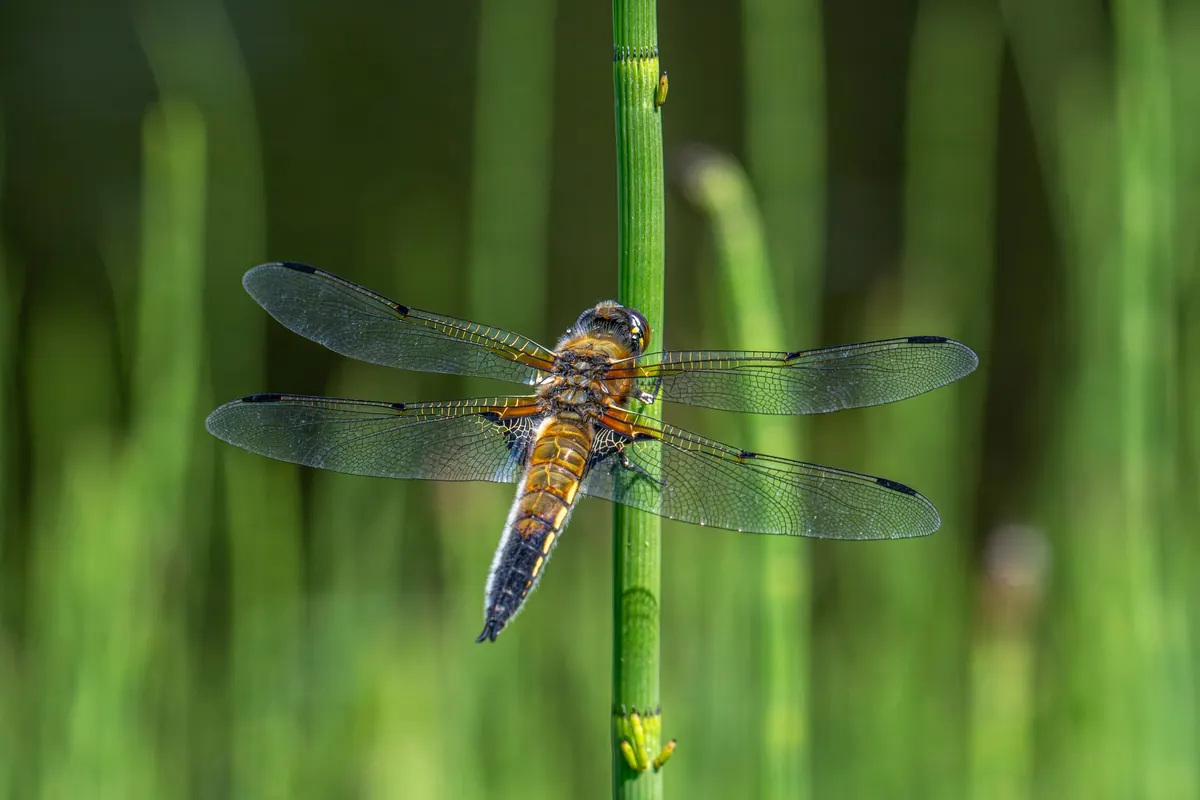
You do not need a net, a hand lens or a specialist's memory to enjoy the dragonflies and damselflies of a British wetland. You need a warm, still afternoon, a little patience, and the knack of telling two insect groups apart. Get that right and a routine circuit of your local pond in July becomes a running list of familiar faces: an azure damselfly on the iris leaves, an emperor quartering the open water, a common darter back on the same fence post it used yesterday.
Two Groups, One Pond Edge
Dragonflies and damselflies belong to the same order, the Odonata, but they split neatly into two. Dragonflies make up the Anisoptera; damselflies the Zygoptera. The differences are visible from a metre or two away, which is exactly what you want when the insect is over water and you are on the bank.
- Build. Dragonflies are sturdy, with broad shoulders and a thick abdomen. Damselflies are fine and needle-like, almost fragile looking.
- Wings at rest. A perched dragonfly holds its wings out flat, or angled slightly forward. A damselfly usually folds them along its back.
- Wing shape. In dragonflies the hindwings are noticeably broader at the base than the forewings. A damselfly's two pairs are much the same shape and narrow where they meet the body.
- Eyes. Dragonfly eyes are huge and meet, or very nearly meet, on top of the head. Damselfly eyes sit well apart, bulging like small dumbbells on either side.
- Flight. Dragonflies fly fast and direct, with sudden changes of direction. Damselflies drift and flutter, looking almost uncertain by comparison.
There are exceptions worth knowing. Emerald damselflies and willow emeralds rest with their wings half open, and a freshly emerged adult of almost any species can look soft and oddly coloured. If in doubt, look at the eyes — that single feature settles most pondside arguments.
A Little Anatomy Goes a Long Way
Identification gets easier once you know which parts to look at. The head carries two large compound eyes and two tiny antennae that are almost useless for spotting. The thorax is the engine room: two pairs of wings and three pairs of legs, all crammed onto a boxy segment behind the head. The abdomen is long, made of ten segments, and it is where most of the colour patterns live.
Look for the pterostigma, a small coloured cell on the leading edge near the tip of each wing. In darters and chasers it is often the quickest clue to a species. At the tip of the abdomen, males have a pair of claspers; females have an ovipositor or a small pair of valves. Colour fades and darkens with age, so learn a species while it is fresh if you can. Newly emerged adults, called tenerals, are pale, glossy-winged and best left unidentified.
Behaviour Worth Stopping For
Emergence
The adults you see on the wing spent months or years underwater as nymphs, hunting tadpoles and small invertebrates among the weed. On a warm morning in late spring or summer they climb a reed or stem, split along the back, and haul themselves out. The empty case, the exuvia, stays behind, sometimes in dozens along a single stretch of reed. Look on the shaded side of a pond first thing.
Territory, courtship and egg-laying
Males of many species hold a stretch of water, chasing off rivals with a rustle of wings. Hawkers patrol long beats, while chasers and darters sit and wait, launching at anything that passes. Pairs mate in the wheel position, the male gripping the female behind the head. Egg-laying follows fast: some species dip the tip of the abdomen into the water, some slice into plant stems, and some do it in tandem with the male still attached and guarding.
Basking and cooling
Odonata cannot regulate their own temperature well. Early in the day they bask on bare ground, fence rails and warm stones, and in the heat of midday some raise the abdomen straight up to reduce the sun's glare — the obelisk posture. Watch for it on the hottest afternoons.
Species to Learn First
Start with the common, distinctive ones and let the rest follow over a season or two.
- Banded demoiselle. Metallic blue-green male with a dark wing patch; slow rivers and canals.
- Large red damselfly. Usually the first damselfly of the year, with black legs and a red abdomen.
- Azure damselfly. Small, blue and black; often the commonest damselfly at a garden pond.
- Blue-tailed damselfly. Dark body with one bright blue segment near the tip.
- Emerald damselfly. Metallic green, resting half open among rushes.
- Emperor dragonfly. Britain's bulkiest dragonfly; males fly a steady, powerful beat over open water.
- Southern hawker. Green and black with blue spots; often hovers close, as if inspecting you.
- Four-spotted chaser. Brown with a dark patch at each wing base; perches and darts out at rivals.
- Broad-bodied chaser. Flattened abdomen, blue in males, golden-brown in females; small ponds.
- Common darter. Red male, ochre female; flies late into autumn and perches on gates and bare earth.
Practical Fieldcraft at the Water's Edge
Timing matters more than equipment. Go on a warm, sunny day with little wind, from mid-morning to mid-afternoon, and after a clear night the morning emergence can be superb. Approach slowly and keep your shadow off the water — a shadow reads as a predator and empties a pond edge in seconds. Stand still and let the insects come to you; hawkers in particular will often circle back.
Cheap binoculars with a close focus are more useful than a long lens. Photograph an unfamiliar insect from the side and from above, and note the date, the site and roughly where you saw it. Records passed to your county dragonfly recorder or the British Dragonfly Society's recording scheme are genuinely useful, even from a garden pond.
Your First Visit: A Simple Plan
- Choose a still, sunny day and arrive mid-morning, with a notebook and binoculars.
- Walk the edge slowly, sun behind you, scanning low over the water, at vegetation height and high above the bank.
- Pick one insect and watch it for two or three minutes before trying to name it. Behaviour narrows the options quickly.
- Check the eyes, the wing position at rest and the abdomen tip. Those three details will get you to the right group every time.
- Write down the date, weather and species, and send your records on at the end of the season.
Do that once a fortnight from May to September and you will finish the year with a shortlist of species you know on sight, and a much sharper eye for everything else on the water.
Photo: Erik Karits / Pexels