Common Mistakes When Identifying UK Wetland Plants (and How to Fix Them)
Most wetland plant names get attached in the first ten seconds of looking. You spot a tall, sharp-edged clump in a fen, decide it is a grass, and then read everything else about the plant through that lens. The rest of your identification quietly bends to fit the first guess.
Good plant identification is less about memory than about habits of looking. The traps below are the ones that catch people most often on reserves, on local wildlife group walks and in their own notebooks. None of them need expensive kit. A hand lens, a notebook and the willingness to slow down will sort most of them.
Sedges, grasses and rushes are three different families
The old rhyme is a decent starting point: sedges have edges, rushes are round, grasses have joints. The trouble is that people treat it as a law rather than a hint, and then stop looking.
What the rhyme is really pointing at is the stem. Roll a stem between finger and thumb and feel for the corners. Most sedges are triangular, with leaves coming off in three ranks, and the leaf sheath wraps right around the stem in a closed tube. Grasses usually have round, hollow stems with obvious joints, leaves in two ranks, and a sheath that splits down one side with a small flap or fringe — the ligule — where blade meets stem. Rushes have round, often pith-filled stems, and their leaves, when they have any, are cylindrical or flat with hairy edges in the wood-rushes.
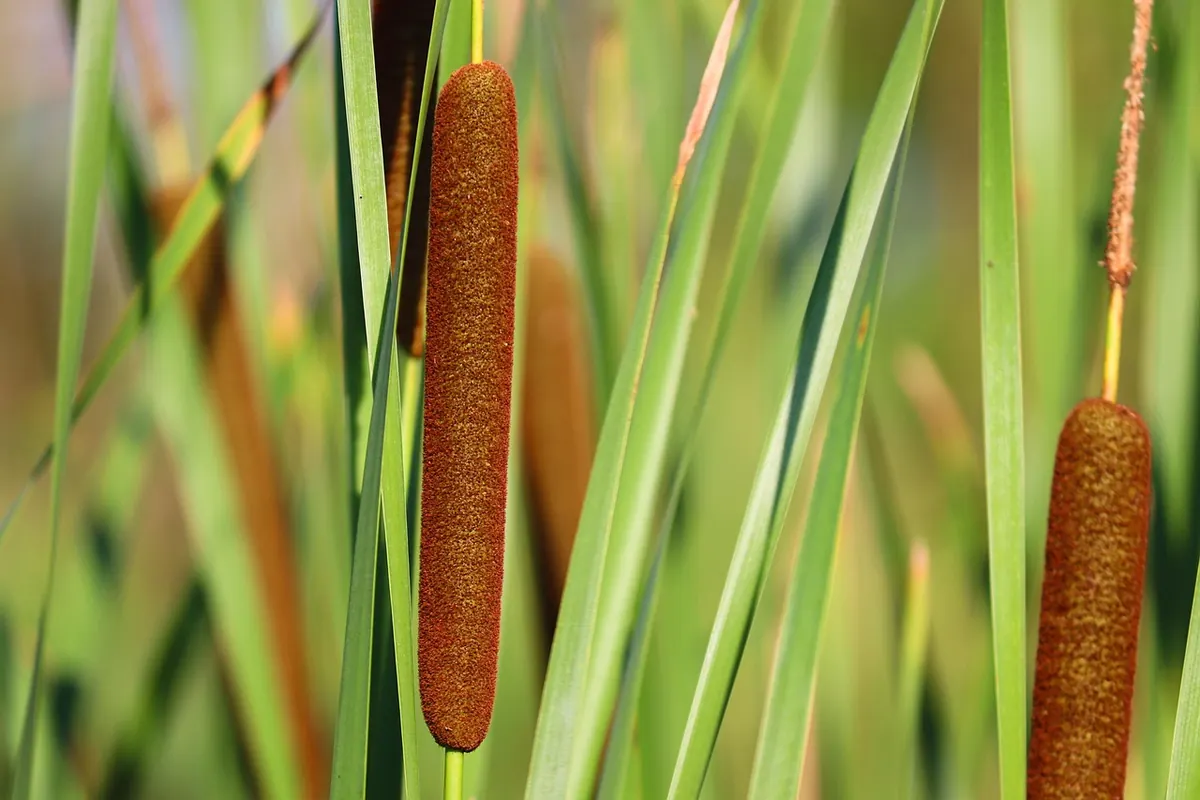
Then remember the exceptions. Some sedges have roundish stems. Some rushes have flat, grassy-looking leaves. Common cottongrass, that white cottony thing swaying over the moss, is a sedge, not a grass and certainly not cotton. And the plant most people call bulrush is really reedmace.
Ignoring leaf arrangement and leaf joins
This is the single most skipped detail, and it is often the one that settles a name. You are looking for two things: how the leaves are arranged around the stem, and how each leaf attaches.
- Alternate, opposite or whorled. Water mint and purple loosestrife hold leaves in opposite pairs or whorls. Common reed and most grasses hold them alternately in two ranks.
- Where the leaves sit. A flat rosette at ground level points somewhere very different from leaves running all the way up the stem.
- The join. Look at the top of the sheath with a hand lens. A ligule, a split sheath, a hairy collar or a pair of tiny ears at the blade base are all useful clues.
- The leaf in cross-section. Many sedge leaves are ridged and keeled, folded into a shallow M. Yellow flag iris leaves are flat, sword-shaped and all arranged in one plane, like a fan.
One more wrinkle: some wetland plants change leaf shape depending on whether they are submerged or standing clear of the water. Arrowhead grows strap-like underwater leaves and arrow-shaped ones in the air. Amphibious bistort and water plantain do something similar. Identify the whole plant, not one leaf.
Trusting colour more than structure
Colour is the least reliable thing on a wetland plant. Light, exposure and age all shift it, and a great many waterside species are small, green and unobtrusive until you get close.
Look at structure instead. Count the petals and note the symmetry. Ask whether the flowers sit in an umbel, a spike, a whorl or singly in the leaf axils. Umbellifers — the carrot family — are a group where this matters twice over: a few wetland members are genuinely dangerous, so never taste or chew a plant to identify it, and wash your hands after handling anything you are unsure about.
Using habitat as the answer instead of the filter
Where a plant is standing is useful, but it is a filter, not a verdict. Base-rich fen, acid bog, ditch, riverbank and tidal mud each support their own typical cast, and knowing that narrows the list quickly.
It narrows it too far when you assume. Common cottongrass and bogbean suggest bog and fen respectively, but both turn up in places that surprise people. Flow, water depth, shade and disturbance all change the picture. Record the habitat as a note, not as proof.
Photographs and apps that leave you guessing
A photo of one flower head in flat light, with nothing for scale, is rarely enough. Take a set instead:
- The whole plant, with your feet or a bag in shot for scale.
- A close side view and front view of a flower.
- The join of leaf and stem, in focus.
- A stem cross-section, or a note of its shape.
- The surroundings, plus a grid reference and the date.
Phone apps are handy for a first suggestion, but treat the answer as a question. Check it against a key or a field guide before writing it down, and be honest when you cannot get past genus. "Carex species, probably pond-sedge" is a perfectly good record.
The habit that fixes most of these mistakes
Write while you are standing there, not an hour later in the car. Note the stem shape, the leaf arrangement, the ligule, the water level, and the two or three features that struck you. Sketch the leaf arrangement looking down from above — three ranks or two? A rough sketch beats a perfect memory.
Then compare like with like. Pond-sedges, for example, are separated by details such as the ligule at the top of the sheath and the arrangement of male and female spikes, so put two suspects side by side rather than trying to recall one.
A short routine for your next wetland walk
- Before naming anything, feel the stem and look down on the leaves.
- Find the leaf join and check for a ligule or a split sheath.
- Note the habitat and water level in your own words.
- Photograph the whole plant and the awkward details, with scale.
- Name it only when two features agree, and leave it at genus otherwise.
Do that for a few visits and the green blur starts to separate. Sedges stop being "grassy things" and become a group with rules you can follow, which is the point at which wetland botany gets genuinely enjoyable.
Photo: manfredrichter / Pixabay