How to Build a Mini Wildlife Pond in a Small UK Garden
Few improvements you can make to a garden do as much for wildlife as a pond. Even a modest one, a metre or so across and dug into a sunny corner, will draw in frogs, newts, dragonflies and a host of insects you have probably never noticed before. It needs no pump, no filter and no fish. What it does need is a little thought about where it goes and how it is built, because a pond that is too shallow, too shaded or too bare will quietly disappoint. Get those basics right and the question that puts most people off, "won't it just breed mosquitoes?", tends to answer itself.
Choosing the Right Spot
Light is the first thing to weigh up. Aim for four to six hours of direct sun each day, which is enough for flowering marginals and enough to bring in dragonflies, but a spot that takes morning sun and some afternoon shade is close to ideal. A pond in blazing sun all day often turns green in its first summer while the plants are still settling in.
Avoid the lowest point in the garden, where water gathers. That is exactly where run-off from paths, lawns and treated decking collects, and with it fertiliser, moss killer and anything else you have used. Keep clear of overhanging trees too: leaves rot down and feed algae, and roots can work their way into a liner. Before you dig, check for buried cables, pipes and land drains.
Finally, put the pond where you will actually see it. A spot visible from a kitchen window gets watched, topped up and enjoyed. If you rent, or live in a leasehold property, check what you are allowed to do before lifting a spade. And if there are toddlers about, plan for either a sturdy grid just below the surface or a fence, at least until they are older.
Size, Depth and Shape
Bigger is more stable, but small absolutely works. A pond of roughly 1.5 by 1 metre is plenty, and a half barrel on a patio will still be colonised. Depth is what matters most: aim for 45 to 60cm at the deepest point, which gives frogs and newts somewhere to sit through a cold snap and stops the pond freezing solid.
Build in two features that make a real difference. First, a shelf around part of the edge at 20 to 25cm deep, to stand marginal plants on. Second, at least one gently sloping section, roughly 30 to 45 degrees, so that anything which falls in can climb out. Vertical sides are a trap for frogs, hedgehogs and thirsty birds.
Curvy, irregular outlines look more natural once planted, but straight-sided shapes are far easier to line. Do not agonise over it; the plants will hide most of your geometry within a season.
Lining Options for a Small Garden
There are three sensible routes, and all of them work:
- Flexible liner (butyl or EPDM) is the most forgiving choice for an odd shape and lasts for decades. Measure the widest and longest dimensions of the hole, then add twice the depth plus 30cm of overlap on every side. Protect it with old carpet, sand or proper underlay.
- A preformed rigid liner is quick to install and comes with shelves moulded in, but shapes are limited and getting it perfectly level takes patience.
- A container pond — half barrel, butler sink, large trug or planter — needs no digging at all and can be moved. Ideal for courtyards and balconies. Never use a barrel that has held chemicals.
Whichever you choose, bury the rim so the liner edge is hidden under turf, gravel or paving. Exposed liner looks tatty and goes brittle in sunlight. Place a few flat stones at the edge so birds and amphibians can drink and climb, but leave one side soft and planted for easy access.
Filling It and Planting It Up
Rainwater is best. Fill from a water butt, or let the pond fill itself over a wet week. Tap water is fine in a pinch; it carries nutrients and a little chlorine, so fill and leave it a week before planting and use it only for occasional top-ups rather than constant refills.
Plant in layers. This is the single best defence against algae and the single best way to make the pond worth visiting:
- Oxygenators in the deep water — hornwort or water milfoil, which compete with algae and shelter invertebrates.
- Floaters — frogbit or a compact water lily, whose leaves shade the water surface.
- Marginals on the shelf — marsh marigold, water forget-me-not, ragged robin, lesser spearwort.
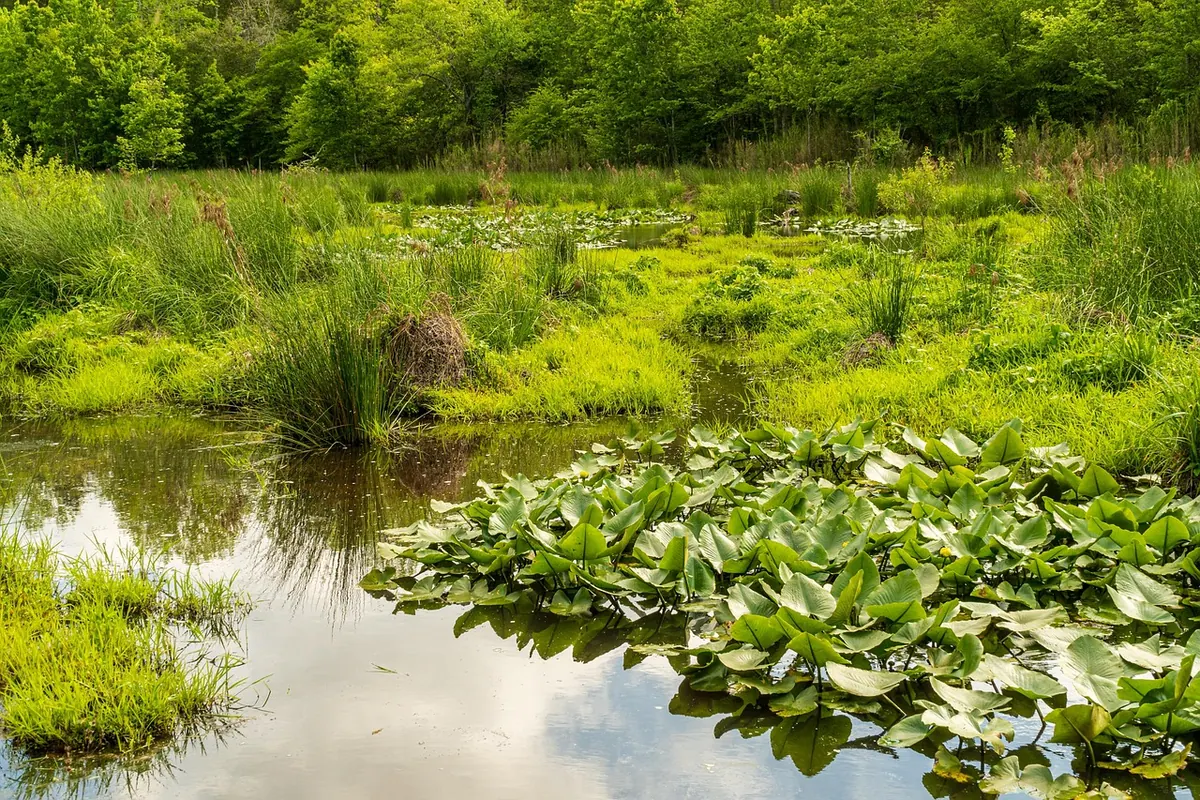
- Damp-edge plants in the soil right around the rim, which wildlife uses as cover to approach the water.
Choose native species where you can; our insects and amphibians evolved alongside them. Steer clear of the invasive non-natives that cause trouble in the wild, such as floating pennywort, parrot's feather and water fern. Never tip pond plants into a river, canal or ditch.
Frogs, Newts and Dragonflies
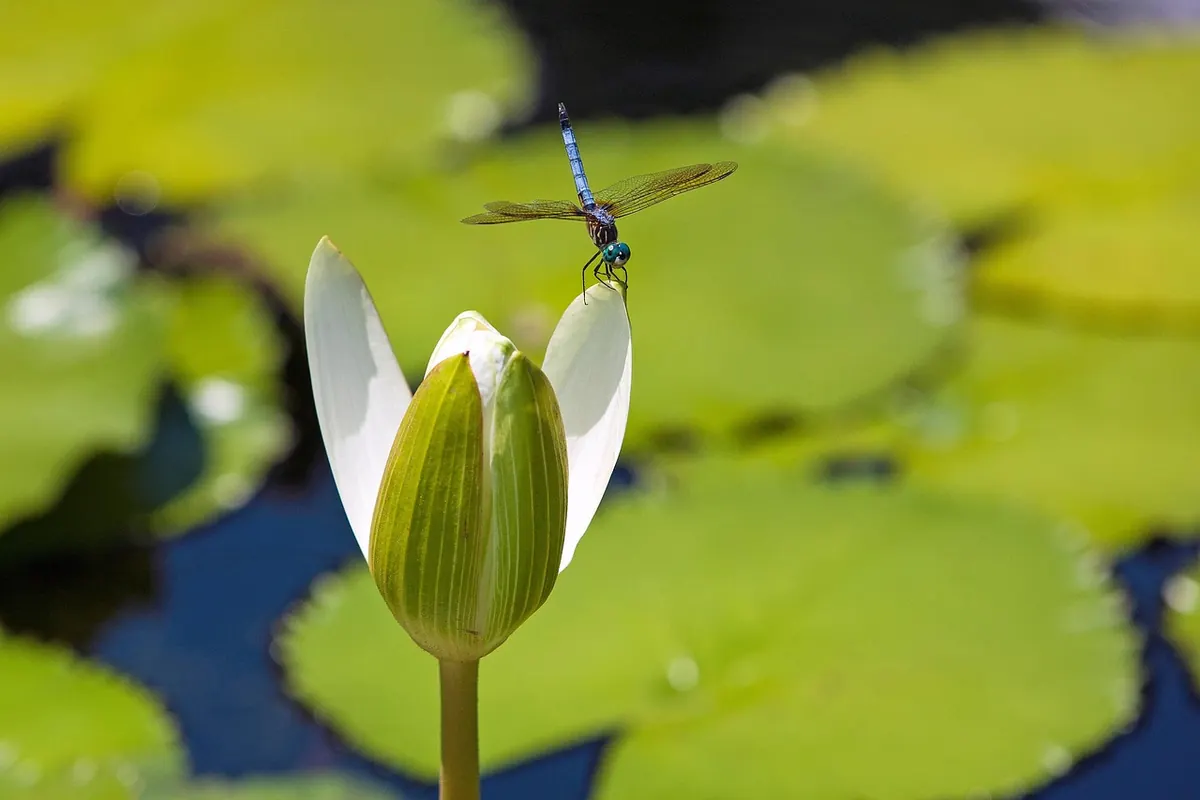
You do not need to stock the pond. Wildlife finds it, usually faster than you expect. Dragonflies and damselflies will patrol within weeks of planting and lay eggs on submerged stems. Frogs turn up from neighbouring gardens, and newts arrive quietly over damp nights.
Resist the temptation to move spawn or adults in from another pond. It risks spreading disease and, for some species, it is against the law. Leave submerged plant stems standing over winter rather than cutting everything back, and a few stones and a small log pile nearby will give amphibians somewhere to hide out of the water.
Why a Planted Pond Is Not a Mosquito Trap
Mosquito larvae need still, nutrient-rich water with nothing in it that eats them. A bare, neglected water butt fits that description perfectly. A planted pond does not. Once it has been colonised by pond skaters, water boatmen, diving beetles, dragonfly nymphs and newts, larvae are on the menu for most of them.
To keep it that way, keep the water off a rich diet: no fertiliser run-off, no grass clippings, no fish food. Do not add fish at all — they eat the invertebrates you want and leave the water green. If you like the sound of moving water, a small solar fountain is fine, but set it off-centre and leave most of the surface still.
Deal with the rest of the garden too. Empty saucers under pots, wheelbarrows and tarpaulins, clear blocked gutters, and cover water butts with a lid or fine mesh over the inlet. Those are the places mosquitoes actually breed in.
Keeping It Going
Maintenance is small and seasonal. In spring, twirl excess blanketweed out with a stick and leave it on the edge overnight so anything caught up can crawl back. Top up in dry spells with rainwater. In late summer, thin plants that have taken over rather than stripping the pond bare.
Never empty and scrub the whole thing. That is the quickest way to lose everything living in it. A pond that looks slightly untidy, with seed heads standing through winter, fallen leaves in the bottom and a scruffy planted edge, is a pond doing its job. Build it, plant it, then leave it alone and watch what turns up.
Photo: tenomgroup / Pixabay